In this guide
- Reconcile your ad bill in five steps
- The missing money sat in the placement report
- One month of ads arrives as many charges
- 2026 moved the bill into some sellers' payouts
- Price each payment method in days of cash
- Credits arrive after the clicks they cover
- Reconcile every month, and keep your own copy
- What you can't fix
- Your ad bill checklist
- Where we fit
- Authoritative resources
- Frequently asked questions
Key takeaways
What changed in Amazon ad billing in 2026, why invoices miss Campaign Manager, and how to pick a payment method before peak season.
- Amazon charges sponsored ads each time clicks reach your credit limit, plus on the 3rd of each month.
- From August 1, 2026, advertisers Amazon contacted pay from their account balance unless they chose Pay by Invoice.
- Pay by Invoice sends one bill at month end, with payment due 30 days later.
- Amazon offered that contacted group $2,500 a month in click credits for five months.
- In a case from about 2023, off-Amazon spend showed only in the placement report.
A seller opened Campaign Manager and saw $850 in ad spend. The invoice for the same dates said more than $2,000.
They checked the dates and opened a case. Then they posted on Seller Forums, in a thread from about 2023: "Campaign manager shows $850 spent while I was invoiced for over $2000.00."
Why doesn't your Amazon ad invoice match Campaign Manager, and what changed in 2026? The bill is a stack of threshold charges, off-Amazon clicks and late credits. Since August 1, 2026, some sellers pay it straight from their payouts. So match it every month, and choose your payment method by when the cash leaves.
Reconcile your ad bill in five steps
- Open the Billing section of the Ads Console and confirm your payment method.
- Download every invoice that covers last month, not only the latest one.
- Export last month's spend for all ad types, plus the placement report.
- List the credits, and pull spend late enough for invalid clicks to drop out.
- Count how many days each payment method keeps cash in your business.
Most charges on that bill started as clicks. Under pay-per-click (PPC) pricing, a view costs nothing, which our guide to the Amazon PPC auction covers along with keywords and bids.
The missing money sat in the placement report
That seller's gap had an explanation, and it came from Amazon.
Amazon's case reply, pasted into the thread, said offsite metrics for Sponsored Products were left out of every report except the placement report. It added that the charge equals the spend on the campaign pages plus the spend in the "Off Amazon" placement group.
So Campaign Manager showed one part of the bill. The invoice charged for both.
Off-Amazon placements are Sponsored Products ads shown outside Amazon's own store. They're billed per click, like any other placement. In that seller's case, Amazon's reply pointed to them as the gap between $850 and more than $2,000.
The seller's advice to everyone else in the thread was short: watch your ad spend invoices.
Check whether your totals include off-Amazon spend
Reports have changed since that thread, so don't assume either way. Pull the Sponsored Products placement report for the same dates and find the Off Amazon row. Add it to the campaign total, then compare again.
If your totals already include it, you've ruled it out in a few minutes. If they don't, add the row and see how much of the gap closes.
My read: check this line first. It's the gap Amazon itself explained in writing in that thread.
If the Off Amazon row turns out to be large, treat it as a decision, not only a billing line. Unlike in 2023, there's now a campaign setting that limits off-Amazon spend, as PPC Land reported in August 2026.
Do this: Pull last month's Sponsored Products placement report. Add the Off Amazon row to your Campaign Manager total before you compare it with the invoices.
One month of ads arrives as many charges
Amazon doesn't send one bill a month. It charges as you go.
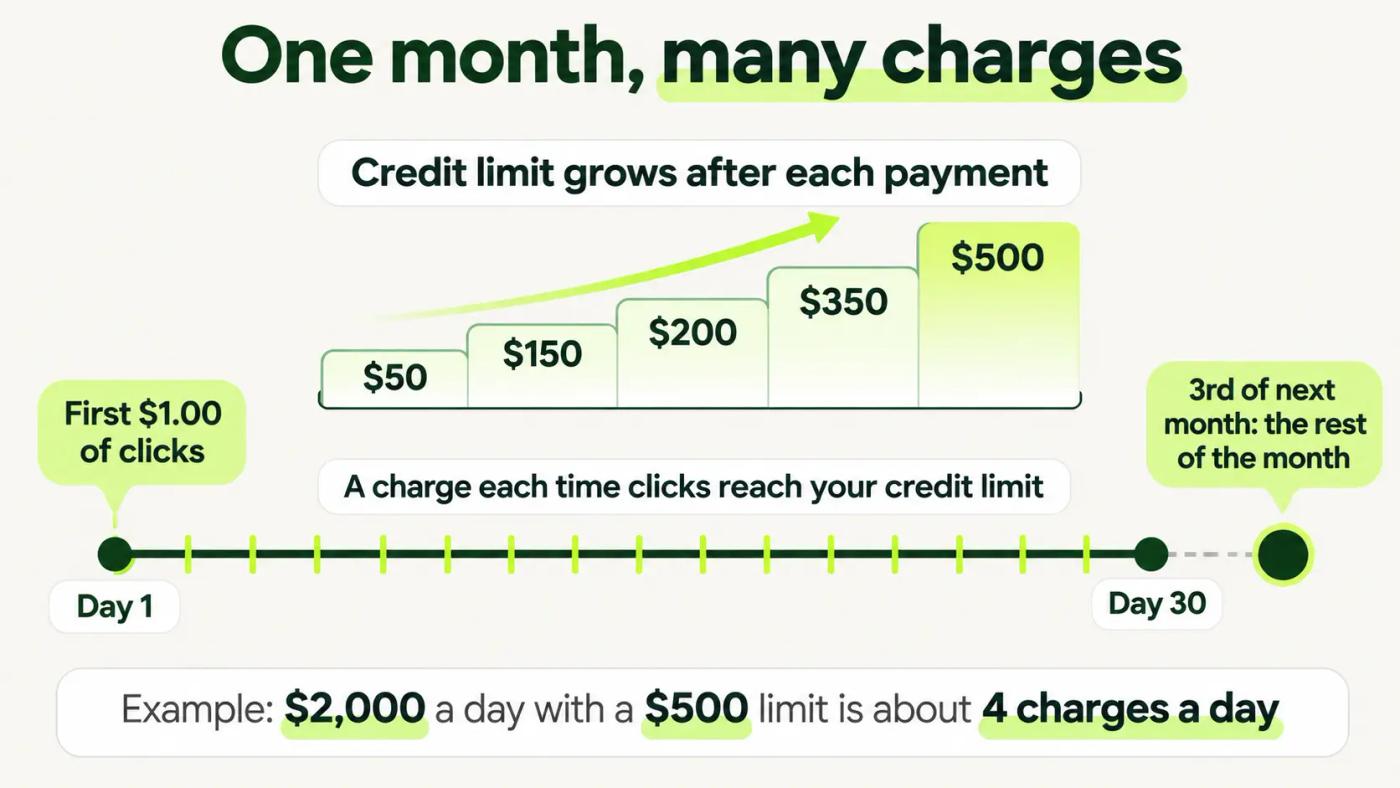
Amazon's advertising FAQ lists the triggers for card and balance payers. You're charged at your first $1.00 of clicks. You're charged again each time clicks reach your credit limit. Whatever is left from the month before is charged "on the third day of each month."
| Trigger | When it fires |
|---|---|
| First clicks | At your first $1.00 of clicks |
| Credit limit reached | Each time clicks reach the limit |
| Month-end balance | On the 3rd, for the month before |
Source: Amazon Ads FAQ, checked November 9, 2026.
The credit limit "begins at $50" and rises after each successful payment: $150, $200, $350, then $500. Some accounts sit higher. A seller on Sellers Ask Sellers wrote in November 2024 that their limit moved to $1,000 in July and $2,000 in September.
Example: at $2,000 a day with a $500 limit, you'd see about four charges a day. That's around 120 charges in a 30-day month. These are example numbers, not client data.
Read the running total, not one invoice
Daily budgets "are not paced throughout the day," the same FAQ says. So a busy morning can set off several charges before noon. Our guide to scaling past $100K a month covers budget pacing, which decides how fast those charges stack up.
The seller with the $2,000 limit posted again in December 2024. The billing page showed a running total once more, under the label "accumulating charge." That figure, not the last invoice, tells you where the month stands.
Do this: Download every invoice that covers last month's clicks, including the charge on the 3rd. Add them up. That sum is the number to match.
2026 moved the bill into some sellers' payouts
In early April 2026, some sellers got a notice that changed when their ad money leaves.
As MediaPost described it, ad costs would come out of retail proceeds first from April 15, 2026. A card would serve only as a backup if proceeds fell short. Eugene Khayman co-founded the seller community Million Dollar Sellers. In a post on X that the same report quoted, he wrote: "It is about cash extraction."
His group organized a 24-hour ad boycott for April 15. Modern Retail reported on April 9, 2026 on a poll of more than 100 of its founders. Most expected the ad payment change and delayed payouts, together, to cut their available cash by more than $100,000.
More than a quarter put the hit above $250,000. Amazon's spokesperson said the change would "align a small subset of sellers with standard practices already used by an overwhelming majority of our selling partners."
What changed on August 1, 2026
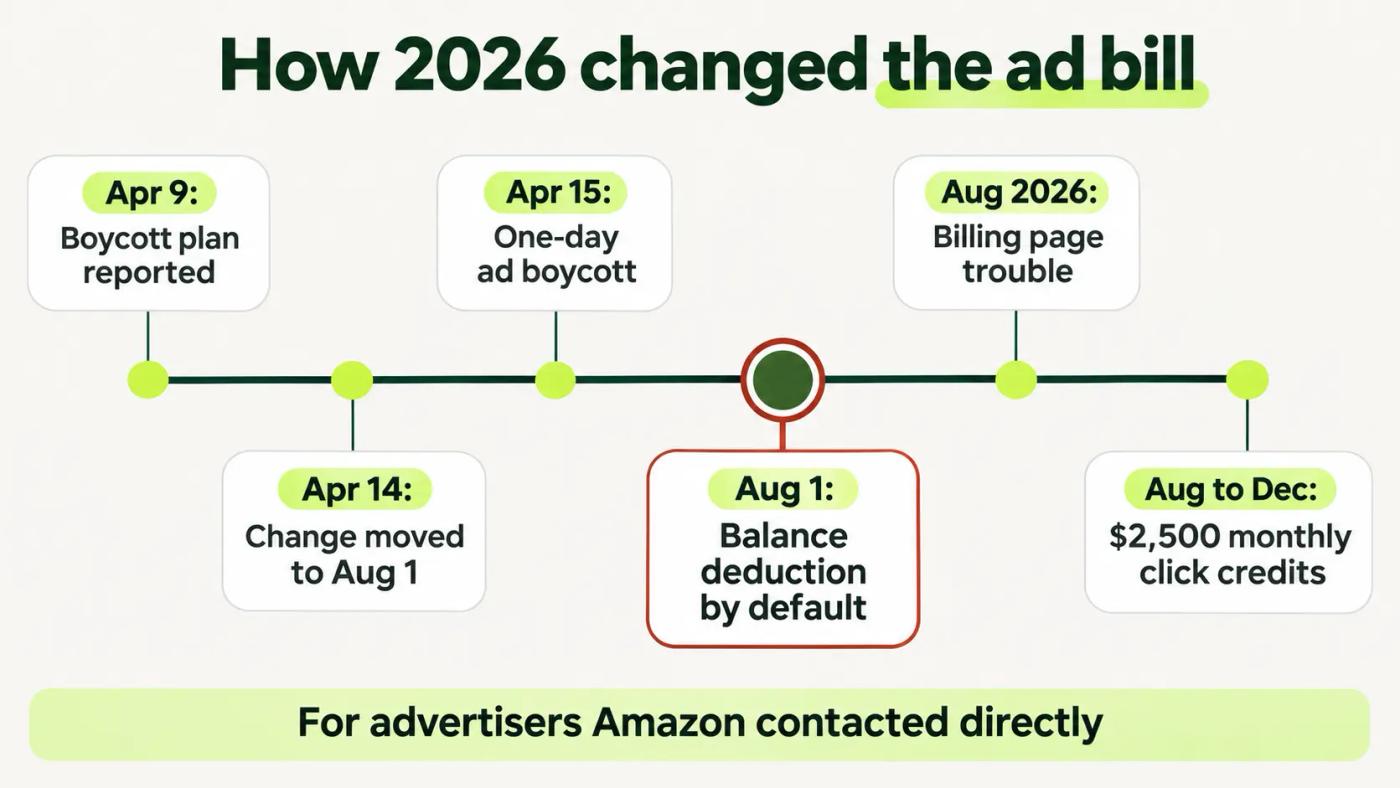
On April 14, 2026, Amazon deferred the change to August 1, 2026. The update "applies only to the small group of advertisers who have been contacted directly." Those advertisers could pay from their seller or vendor balance, or choose Pay by Invoice.
Anyone who chose nothing would move to balance deduction by default. The card on file stays as a backup when the balance runs short.
PPC Land reported that Amazon offered the affected group $2,500 a month in click credits for five months, starting August 1, 2026. The details sit on the Promotions page in the account, or in Amazon's email.
| Date | What happened | Source |
|---|---|---|
| April 9, 2026 | Sellers plan a one-day ad boycott over payment changes | Modern Retail |
| April 14, 2026 | Amazon defers the change to August 1, 2026 | Amazon Ads |
| April 15, 2026 | The original start date, and the boycott day | MediaPost |
| August 1, 2026 | Contacted advertisers move to balance deduction unless they chose | Amazon Ads |
| August 2026 | Sellers report trouble with the ads billing page | Sellers Ask Sellers |
| August to December 2026 | $2,500 a month in click credits for the contacted group | PPC Land |
Dates as announced or reported. Checked November 9, 2026.
We found no later Amazon notice moving the August 1 date, as of November 9, 2026.
My read: most advertisers saw no change, since Amazon says most already pay from their balance. But the notice raised a question for everyone: when does your ad money actually leave?
If you're not sure which rule you're on, bring two months of invoices to a free strategy session. It's 30 minutes with a senior strategist.
Do this: Search your inbox for Amazon Ads payment emails from April 2026. Then open the Billing section of the Ads Console and the Promotions page.
Price each payment method in days of cash
The method doesn't change what you spend. It changes how long the cash stays with you.
| Method | When cash leaves | Who can use it |
|---|---|---|
| Seller or vendor balance | As charges post, before your payout | Most advertisers already do |
| Credit card | When your card bill is due | Advertisers Amazon didn't contact; backup for those it did |
| Pay by Invoice | 30 days after the month-end invoice | The contacted group; vendors by invite |
Sources: Amazon Ads FAQ and Amazon's April 14, 2026 update.
Say you spend $60,000 a month, about $2,000 a day. With balance deduction, each charge comes out of your seller balance within days of the clicks. With Pay by Invoice, the average click gets paid about 45 days later: half a month to the invoice, then 30 days.
That gap is about 45 days of spend. At $2,000 a day, it's roughly $90,000 that stays in your business. These are example numbers, not client data.
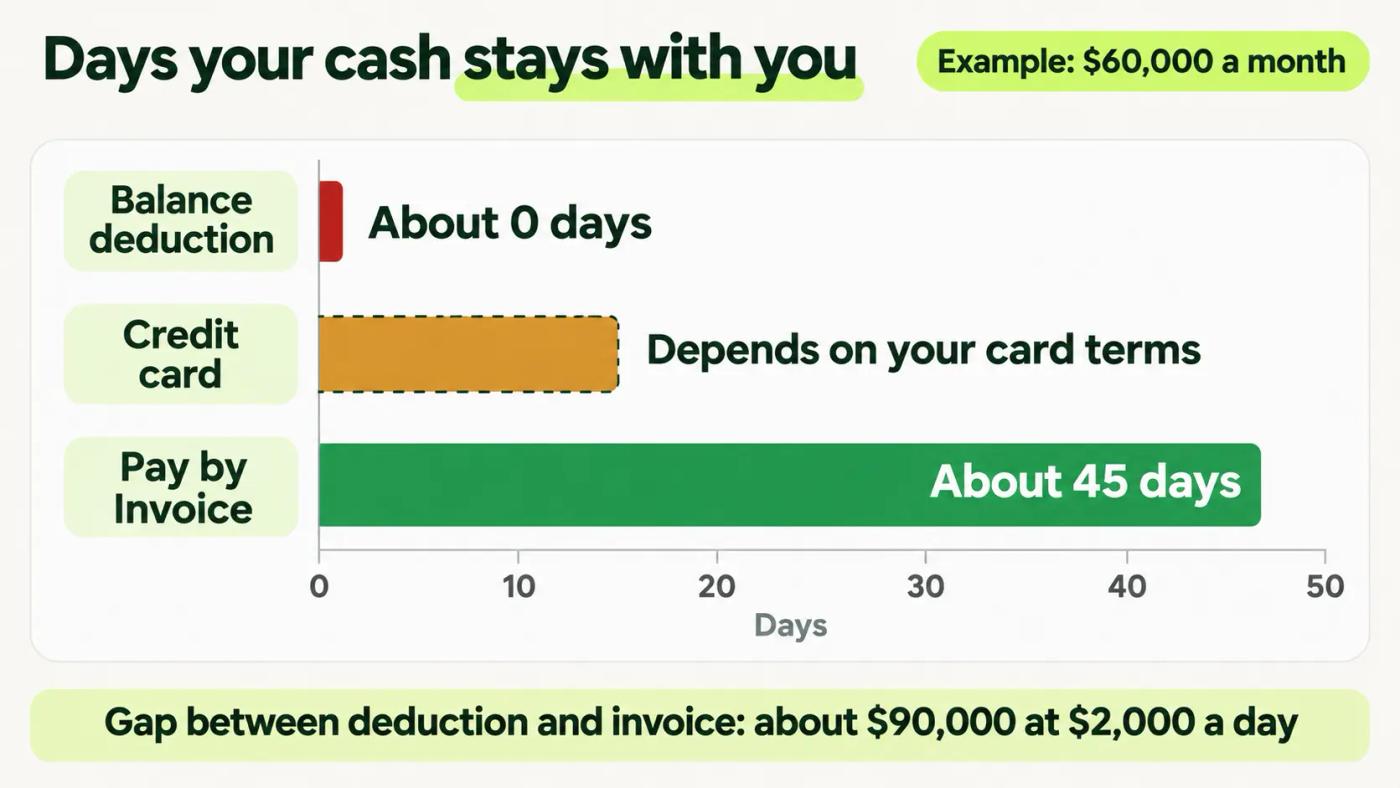
A card sits between the two, and your statement date and grace period decide where. Example: a statement closes on the 25th and is due 25 days later. Charges from April 26 to May 25 land on one statement, due June 19. The average charge waits about 40 days. Card terms vary, so check yours.
The card's limit has to carry a full cycle of charges, too. At $60,000 a month, that's a lot of limit to keep free in peak season.
Rewards count as well. PPC Land's example: a seller earning 2% back on $50,000 a month would give up $12,000 a year by leaving the card.
Add the agency fee to the same sheet
Our cost breakdown defines your Amazon PPC cost as ad spend plus fees plus management. The bill in this post is only the first of those three.
Management is the third part, and its fee model matters here. A fee set as a percentage of ad spend climbs with every Amazon invoice. So a heavy fourth-quarter (Q4) bill raises two bills at once.
My read: for Q4, map cash by week, not by month. Ad charges, payouts and inventory deposits don't land on the same schedule.
Do this: List each month's planned ad spend through December 2026. Next to each, write the date that cash leaves under your current method.
Credits arrive after the clicks they cover
Some of the numbers you compare will move after the month closes.
On September 30, 2022, Amazon added a gross and invalid traffic report to the Ads Console report center. It shows gross clicks, invalid clicks and the invalid click rate for Sponsored Products, Sponsored Brands and Sponsored Display.
In a 2026 Seller Forums thread, an Amazon representative wrote: "Invalid spend that's caught retroactively is credited back to the campaign budget." So a spend figure you pull on the 1st can shrink later.
The seller who started that thread counted 7,954 invalid clicks in six weeks, using Amazon's own report. They checked their billing and said the invalid clicks were excluded from charges. The report showed the clicks. By their check, the bill left them out.
Promotional credits can lag too. On Amazon's Canadian Seller Forums, a seller described a November 2024 offer. They paid for the full $500 of clicks first. The credit was due within 14 days of qualifying. It came after about 25 days, and only after several support cases.
| Credit | Where to see it | When it lands |
|---|---|---|
| Invalid clicks | Gross and invalid traffic report | After Amazon's filters catch them |
| Promotional credits | Promotions page | After the qualifying action |
| 2026 click credits | Promotions page or email | Monthly, August to December 2026 |
Sources: Amazon Ads, Seller Forums, PPC Land.
My working rule: reconcile on the 5th. The charge for the month before posts on the 3rd, so by the 5th the month is billed.
Do this: Add a credits column to your sheet. Log each credit against the month of the clicks it covers, not the month it arrived.
Reconcile every month, and keep your own copy
Six lines tell you whether the bill is right.
| Line | Where to find it | Example |
|---|---|---|
| Spend, all ad types | Campaign Manager, pulled on the 5th | $58,400 |
| Off Amazon row, if not in totals | Placement report | $1,600 |
| Promotional and click credits | Promotions page | -$2,500 |
| Expected charges | Lines 1 to 3 added | $57,500 |
| Billed | Sum of last month's invoices | $57,640 |
| Gap | Billed minus expected | $140 |
Example rows, not client data.
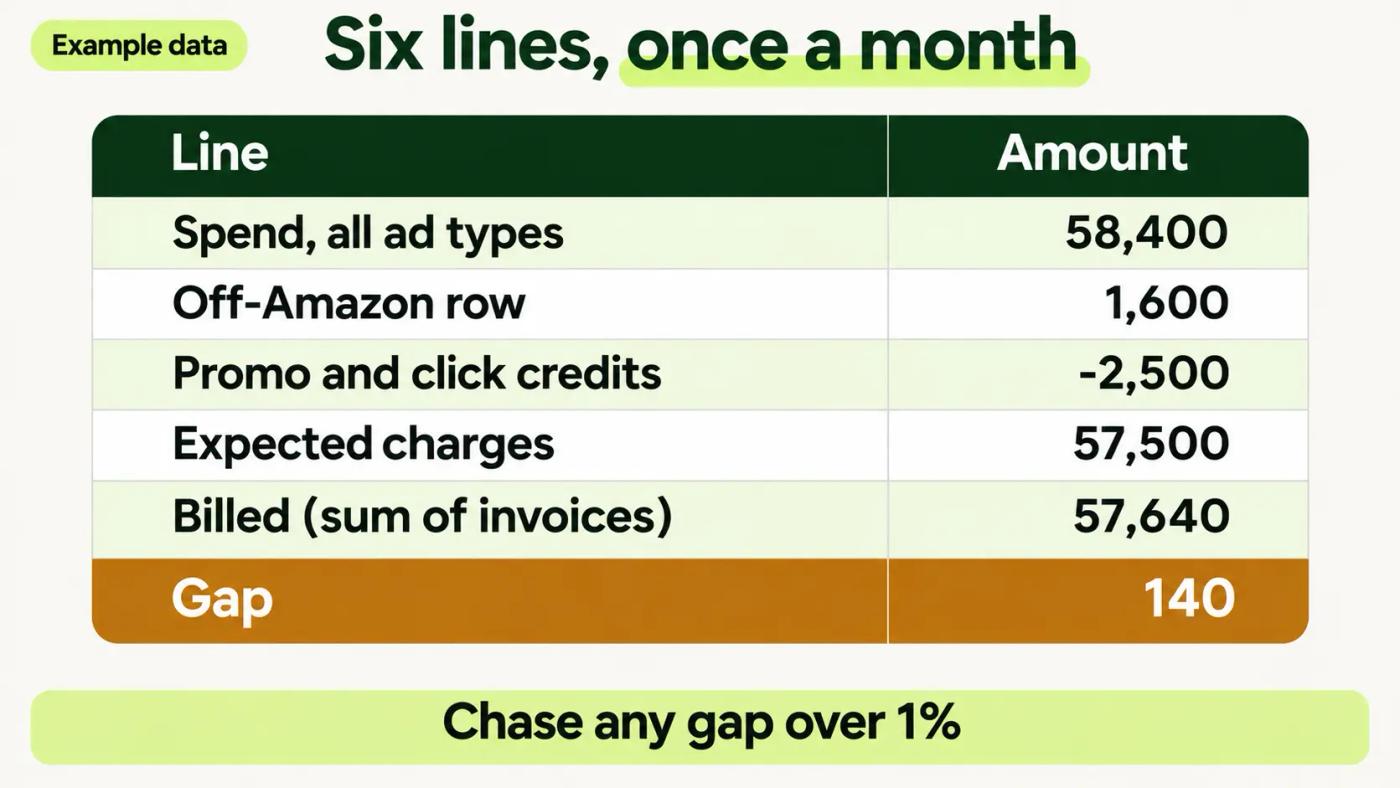
In this example the gap is $140, about 0.2% of the bill. My working rule: chase any gap over 1%, and any line you can't name.
If a gap survives the six lines, open a case with Amazon Ads support. Attach the sheet, the invoice numbers, the dates and the placement rows. The seller from the opening got their answer that way. Write the case number on the sheet, next to the month, so next month's check starts from it.
When the billing page goes dark
In August 2026, sellers reported trouble with the very page this check depends on. On September 1, 2026, a seller on Sellers Ask Sellers posted the notice they saw: "We're investigating a temporary interruption in our sponsored ads payment."
It added, "We're working to fix it," and said no campaign bills had been lost. Three days later, another seller wrote about the August and September invoices: "now we're in the dark about two of them."
That's why the sheet should live with you, not only with Amazon. Save each invoice the week it posts. Payment settings sit in the Billing section of the Ads Console, and our 2026 roundup compares that console with Seller Central.
If an agency runs your ads, ask for this match in its monthly report. Our guide to choosing an agency for a 7-figure brand asks for transparent reporting and raw data you can check yourself.
Do this: On the 5th of each month, fill in the six lines for the month before. Save every invoice file in the same folder.
What you can't fix
You can't choose Pay by Invoice unless Amazon offers it to you. Amazon's FAQ calls invoicing invite-only for vendors.
You can't audit the price of each click from the bill. On August 31, 2026, the Federal Trade Commission (FTC) and 22 states sued Amazon, alleging hidden surcharges in its ad auctions. A court will decide that, not your spreadsheet.
You can't make credits arrive faster, or make Amazon's pages load when they're down. And you can't stop the menus moving. Adweek reported on September 29, 2026 that Amazon Ads Agent replaces the Ads Console, so the Billing section may change names.
And one limit on our side: we haven't published a client's invoice reconciliation. This post uses Amazon's notices and FAQ, trade press, and seller threads.
Your ad bill checklist
- Payment method confirmed in the Billing section of the Ads Console
- Inbox searched for Amazon's April 2026 payment notice
- Promotions page checked for click credits
- Every invoice covering last month downloaded
- Last month's spend for all ad types exported
- Off Amazon row added from the placement report
- Credits logged against the month they cover
- Gap worked out, with a case opened if it's over 1%
- Q4 cash dates mapped for your payment method
Where we fit
We run Amazon PPC for brands spending $10K or more a month. Amazon bills your ad spend to you directly, and it never passes through us. Our fee is flat, so a bigger Amazon invoice never raises it.
Want an outside read before Q4 charges peak? Our free audit turns your account into a prioritized action list, delivered within 24 hours. No pitch.
If you spend under $10K a month, the checklist above is enough to run on your own.
Authoritative resources
- Seller Forums invoice gap threadThe $850 versus $2,000 case and Amazon's reply.
- Amazon Ads FAQWhen Amazon charges, and how credit limits grow.
- MediaPost on the ad boycottThe "cash extraction" quote and the notice text.
- Modern Retail on the boycott planThe founders' cash poll and Amazon's statement.
- Amazon update on advertiser paymentsThe August 1, 2026 date and payment options.
- PPC Land on the payment delayPay by Invoice timing and click credits.
- Sellers Ask Sellers console threadThe August 2026 billing page outage.