In this guide
- Reset your bids in five steps
- The 80% figure is an FTC allegation, not a ruling
- Amazon's own account says some clicks cost your full bid
- Measure how often you pay your own bid
- Set each bid ceiling from break-even math
- Recheck dynamic bidding and placement boosts
- Stop treating suggested bids as targets
- Keep your own records starting this week
- What you can't fix
- Your bid reset checklist
- Where we fit
- Authoritative resources
- Frequently asked questions
Key takeaways
What the Federal Trade Commission (FTC) lawsuit claims about Amazon ad pricing, and how to reset your Sponsored Products bids around your margins.
- The FTC and 22 states sued Amazon on August 31, 2026. No court has ruled on the claims.
- Per the FTC, the full-bid share of clicks was 30% to 40% in 2021 and about 80% by 2024.
- Amazon says no advertiser pays more than their bid, yet a winning bid below its soft reserve pays in full.
- Dynamic bidding can double a bid, and placement adjustments can add up to 900%.
- Break-even cost per click (CPC) equals profit per sale before ads times conversion rate.
"If your ad is clicked, you will pay an amount slightly higher than the second highest CPC bid."
That is how Amazon's own training explained click prices, per an FTC complaint filed August 31, 2026. The complaint says that by 2024, Sponsored Products advertisers paid their own winning bid close to 80% of the time.
How should you set Amazon bids now? Treat every bid as the price you will pay. The FTC's claims are unproven, and Amazon denies misleading anyone. But Amazon's own response says a bid that lands between its two reserve prices pays in full. Your bid is often your price, whoever wins the case.
Reset your bids in five steps
- Divide each keyword's CPC by its bid to see how close your price runs to your full bid.
- Set a ceiling: profit per sale before ads times conversion rate.
- Halve the base bid on any campaign using dynamic bids up and down.
- Treat suggested bids as Amazon's number, not your target.
- Save your bids and CPC every week, starting now.
New to pay-per-click (PPC) terms? Our guide to the Amazon PPC auction covers keywords, match types, and the metrics used below. Everything here assumes you can open your own campaign manager.
The 80% figure is an FTC allegation, not a ruling
On August 31, 2026, the FTC and 22 states sued Amazon in the U.S. District Court for the Western District of Washington. The FTC's announcement says Amazon "has likely extracted tens of billions of dollars from its unwitting advertising customers."
What the complaint alleges
The FTC complaint opens with a promise. Since about 2012, it says, Amazon told advertisers its auctions were "second price." The winner would pay only the minimum needed to beat the runner-up, such as one cent more.
Then, in late 2018 and early 2019, the complaint says Amazon began "secretly overriding" those prices. The new floor was called a "soft reserve" price. The complaint tracks how often Amazon then charged the full winning bid.
| Year | Share of Sponsored Products clicks charged the full winning bid | Source |
|---|---|---|
| 2021 | 30% to 40% | FTC complaint, paragraph 65 |
| 2022 | 70% | FTC complaint, paragraph 65 |
| 2024 | About 80% | FTC press release; complaint, paragraph 76 |
Source: FTC complaint and press release, both dated August 31, 2026.
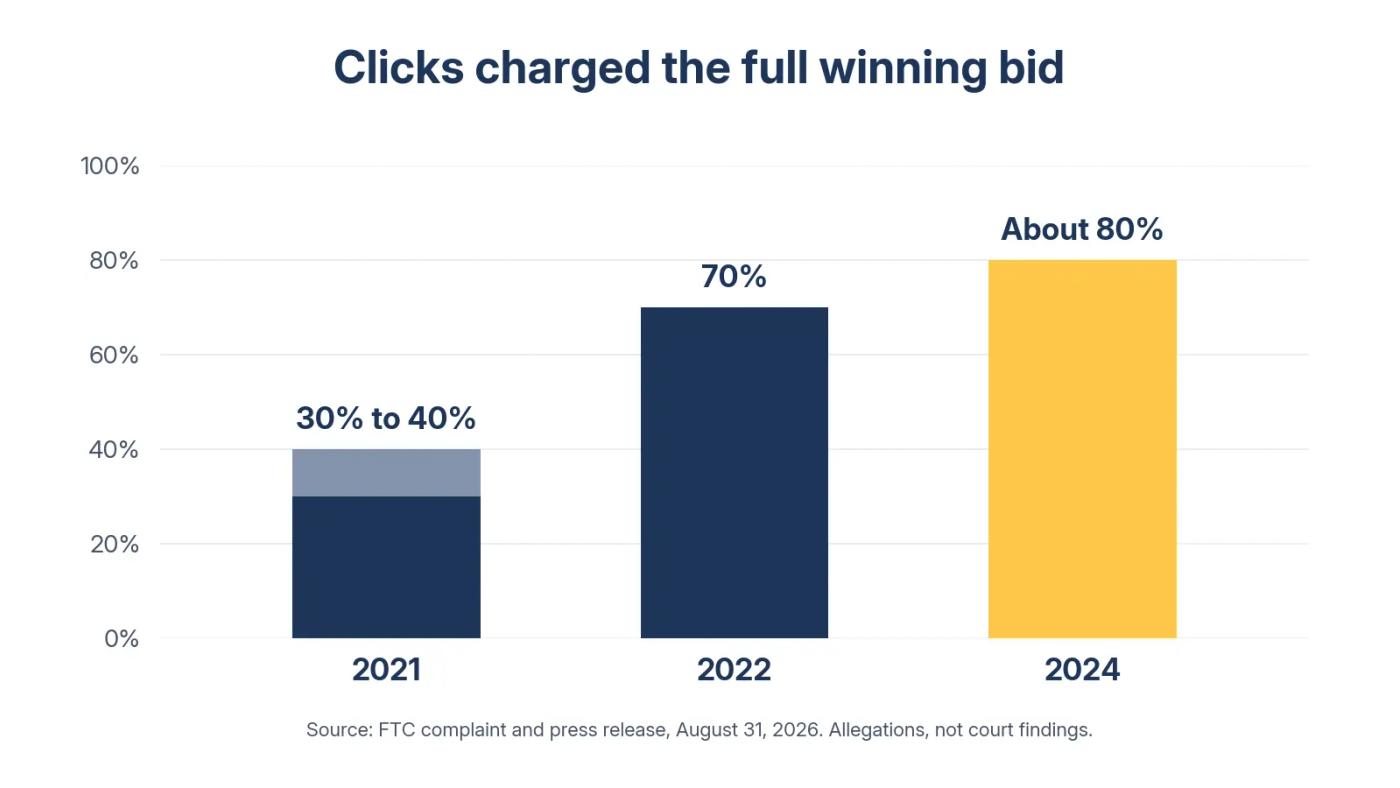
Read the table top to bottom. In three years, the full-bid click went from a minority to the normal case.
Meanwhile, an Amazon help page still said, "Bidding on Amazon Ads is a second price auction." The complaint says that page ran from 2022 to 2024.
What it does not prove
These are claims, not findings. No judge has ruled, and Amazon says, "We look forward to making our case in court."
Amazon also has its own numbers. It says advertisers saved over $8 billion from 2021 to 2025. It says average CPC stayed flat from 2019 through 2024 after inflation. Those are Amazon's figures, and the court will weigh both sides.
The suit names Sponsored Products, Sponsored Brands, and display ads alongside search results. The 80% figure covers Sponsored Products only, so run the steps below on all three self-service ad types you buy.
Do this: Read paragraphs 2, 65, and 76 of the complaint yourself. It takes five minutes, and you will know exactly what is alleged.
Amazon's own account says some clicks cost your full bid
Amazon posted its response the same day. It calls the claim of a company-wide effort to deceive advertisers "patently false." But it also explains its two reserve prices in plain terms.
How Amazon describes its reserves
A hard reserve, Amazon says, is "the minimum a bid must surpass to enter an auction." A soft reserve is what Amazon estimates to be "the true market value of the ad placement."
| Where your winning bid lands | What Amazon says you pay |
|---|---|
| Below the hard reserve | Nothing. Your ad does not enter the auction |
| Above the hard reserve, below the soft reserve | Your full bid |
| Above both reserves | The soft reserve, which is less than your bid |
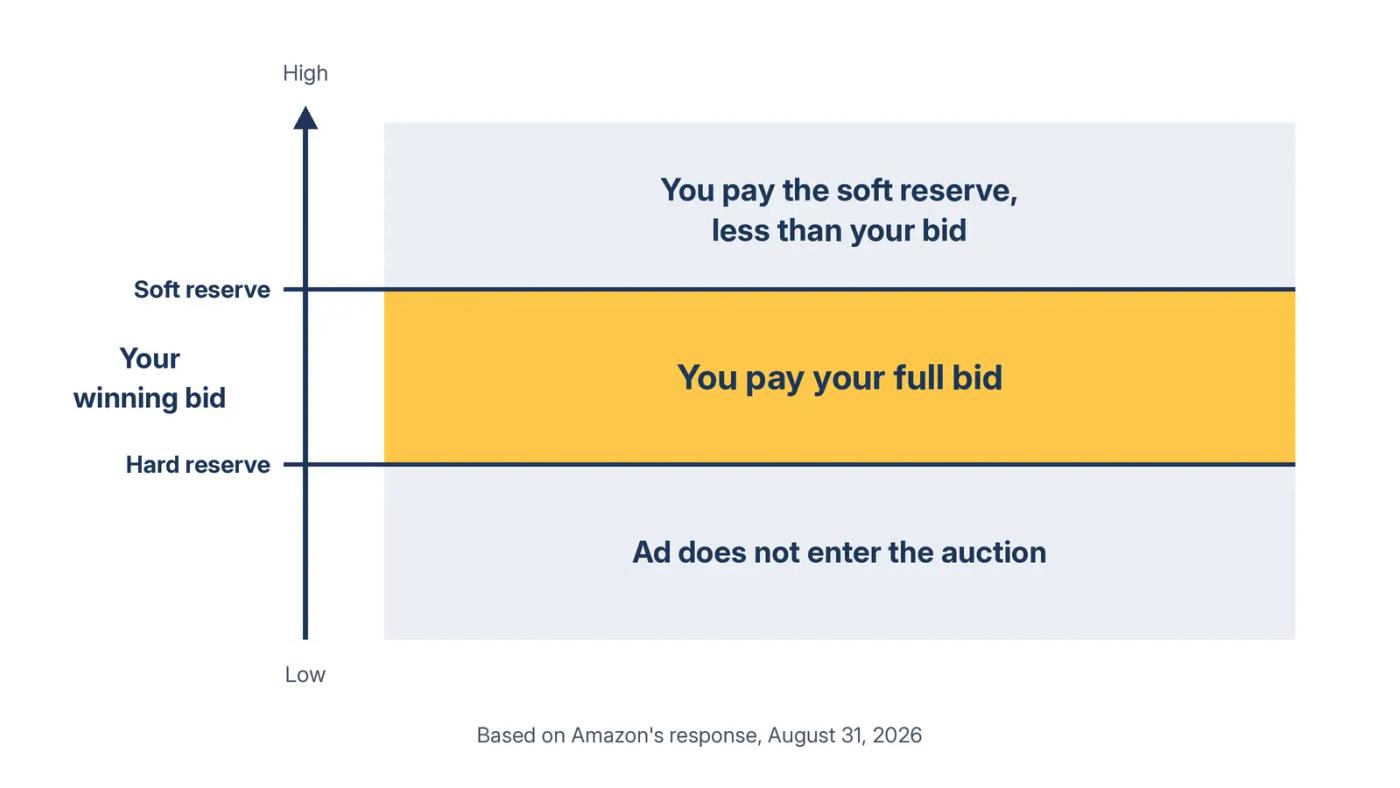
In Amazon's words, a bid that clears the hard reserve but misses the soft one still wins, and "they pay their bid." Amazon adds, "In no scenario does an advertiser pay more than their bid."
My read: both sides describe the same mechanics. They disagree on whether sellers were told. If the FTC's numbers hold, about 80% of clicks landed in that middle row.
What the middle row costs you
Here is a made-up example to show the gap. You bid $1.50. The next bidder offers $0.90. Under the second-price rules Amazon described, you would pay about $0.91.
Now say the soft reserve for that slot is $1.80. Your bid clears the hard reserve but misses the soft one. You pay $1.50.
That is $0.59 more per click. Across 1,000 clicks a month, it adds up to $590. Nothing in your report flags it. Your CPC simply sits close to your bid.
Amazon also says about 92% of selected Sponsored Products ads "were not the highest bid." So relevance matters. Your bid caps your price, but it does not buy the slot on its own.
Whoever runs your Amazon PPC management, in-house or agency, should now plan from bid ceilings, not average CPC. The average hides the clicks that cost the full bid.
Do this: Stop reading your average CPC as a discount off your bid. Read each bid as a price you agreed to pay.
Measure how often you pay your own bid
You can't see the soft reserve. Amazon says reserves "aren't predictable in advance by anyone." But you can see the result in your own reports.
Pull two numbers per keyword
Open your Sponsored Products targeting report for the last 30 days. Note each keyword's CPC, which is total spend divided by total clicks.
Next, copy each keyword's current bid from the campaign manager or a bulk file. Use keywords whose bids did not change during those 30 days. A bid that moved mid-month makes the math useless.
Score each keyword
Divide CPC by bid. A keyword with a $1.20 bid and a $1.17 CPC scores 0.98. That keyword pays close to its full bid on most clicks.
A score near 0.60 tells a different story. A real share of its clicks cost well under the bid.
My working rule: treat any keyword scoring 0.90 or higher as a full-bid keyword. Its bid is its price, so it must pass the ceiling test in the next section.
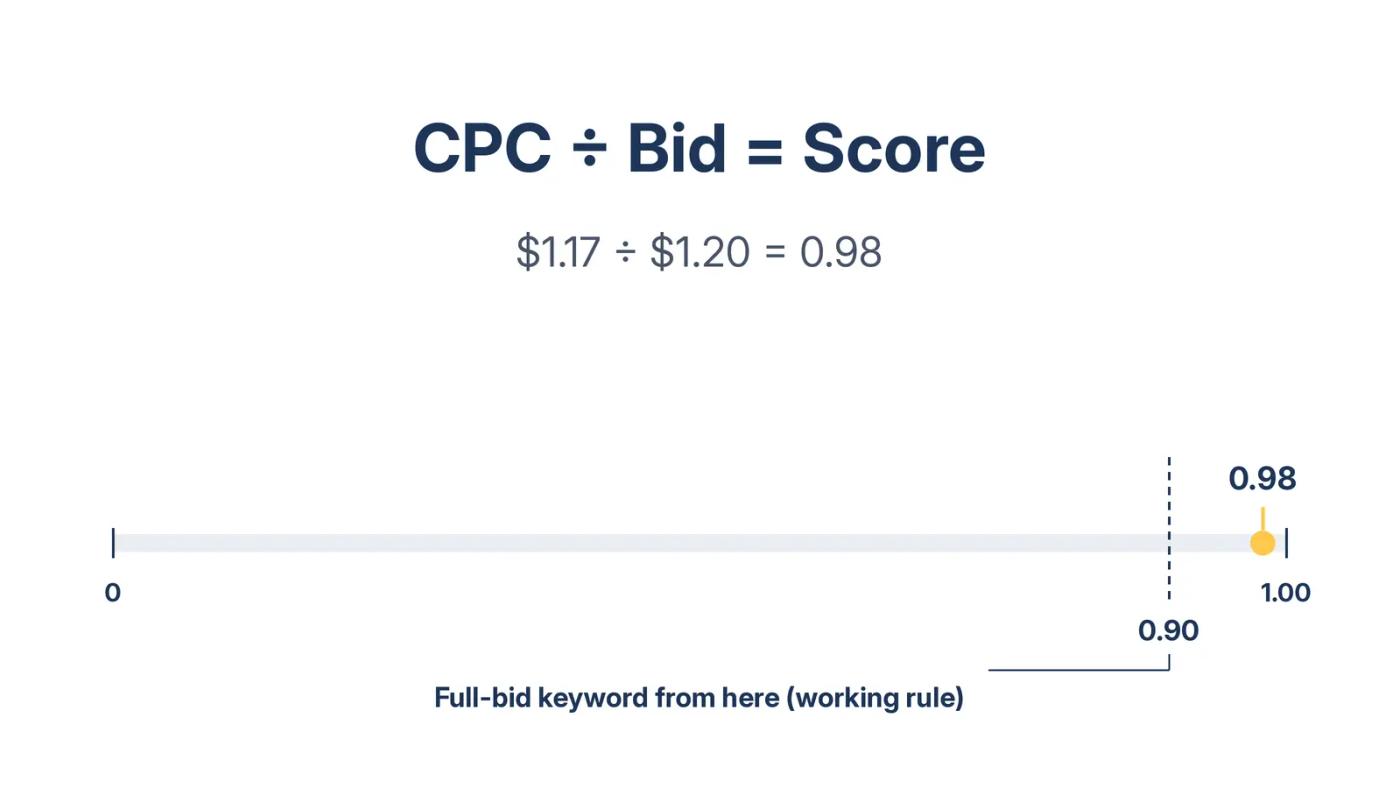
Keep one limit in mind. The score is an average. A 0.90 could mean 80% of clicks at full bid and 20% at half. You will never see the price of a single click.
One trap: dynamic bids up and down can push CPC above your base bid, so the score can top 1.00. Test on fixed-bid campaigns with no placement adjustments first. There, Amazon uses your bid exactly as entered.
Act on the full-bid keywords
Full-bid keywords are not bad keywords. Many are your best converters. They just need a bid you can afford to pay on every click.
For each flagged keyword, compare its bid to the ceiling you will set in the next section. If the bid sits above the ceiling, that keyword moves to the top of your fix list.
Then feed the scores into an SQP-driven bid system, which reads Search Query Performance (SQP) share signals to set bid rules. Scores tell you what you pay. SQP tells you what you are winning.
If you want a second read of your scores, our strategy session is 30 minutes, one to one, with a senior strategist.
Do this: Score your top 20 keywords by spend this week. Flag every keyword at 0.90 or higher.
Set each bid ceiling from break-even math
When a click often costs your full bid, each bid must pass one test. Could you afford to pay it on every click?
Use one formula
Break-even CPC = profit per sale before ads × conversion rate.
Profit per sale before ads is your price minus product cost, Amazon fees, and shipping. Conversion rate is orders divided by clicks for that keyword.
Run the numbers
These are example numbers, not client data.
| Price | Costs before ads | Profit before ads | Conversion rate | Break-even CPC | Ceiling to keep $3 profit |
|---|---|---|---|---|---|
| $20 | $13 | $7 | 10% | $0.70 | $0.40 |
| $35 | $21 | $14 | 12% | $1.68 | $1.32 |
| $60 | $33 | $27 | 8% | $2.16 | $1.92 |
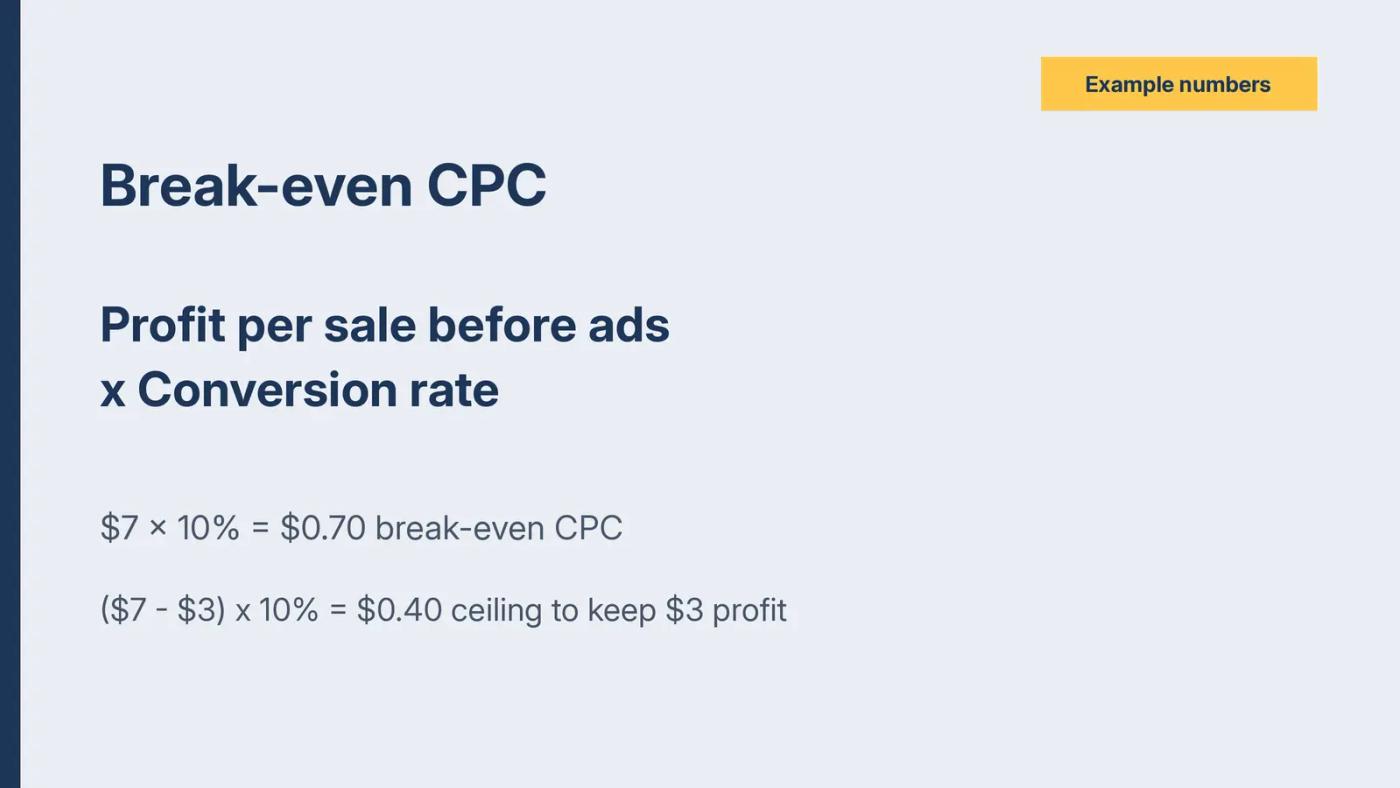
The last column is your bid ceiling. Break-even only means you lose nothing on the ad. You still want to keep something.
This is the same margin math behind break-even ACoS. Advertising cost of sales (ACoS) at break-even equals profit before ads divided by price. Row one breaks even at 35% ACoS.
Conversion rate is the easiest input to get wrong. Check the median click price for each search term in Brand Analytics. If your price sits well above it, expect a lower rate than your account average.
Do this: Build this table for your top 10 products tonight. Use 60 days of conversion data, not 7.
Recheck dynamic bidding and placement boosts
Your base bid is not your ceiling. Amazon's Sponsored Products best practices guide calls your adjusted bid "the maximum amount that you're willing to pay."
Dynamic bids up and down
Amazon's dynamic bidding guide says it can raise or lower bids "by up to 100% for all placements based on performance." Its own example turns a $1.00 bid into a $2.00 maximum.
The guide also warns, "Ensure you are prepared to potentially spend double the amount of the bid you input."
My read: if most clicks cost the adjusted bid, that double is a likely price, not a rare worst case. So halve the base bid on any up-and-down campaign. A $1.68 ceiling means an $0.84 base bid. Or switch the campaign to dynamic bids down only.
Placement adjustments
Placement adjustments raise bids for top of search, rest of search, or product pages. Amazon lets you add up to 900%. A $0.40 base bid with a 300% top-of-search adjustment becomes $1.60.
The complaint adds that rule-based bidding can raise bids up to 500% for each placement opportunity. Each feature can help. Each one also moves your real ceiling.
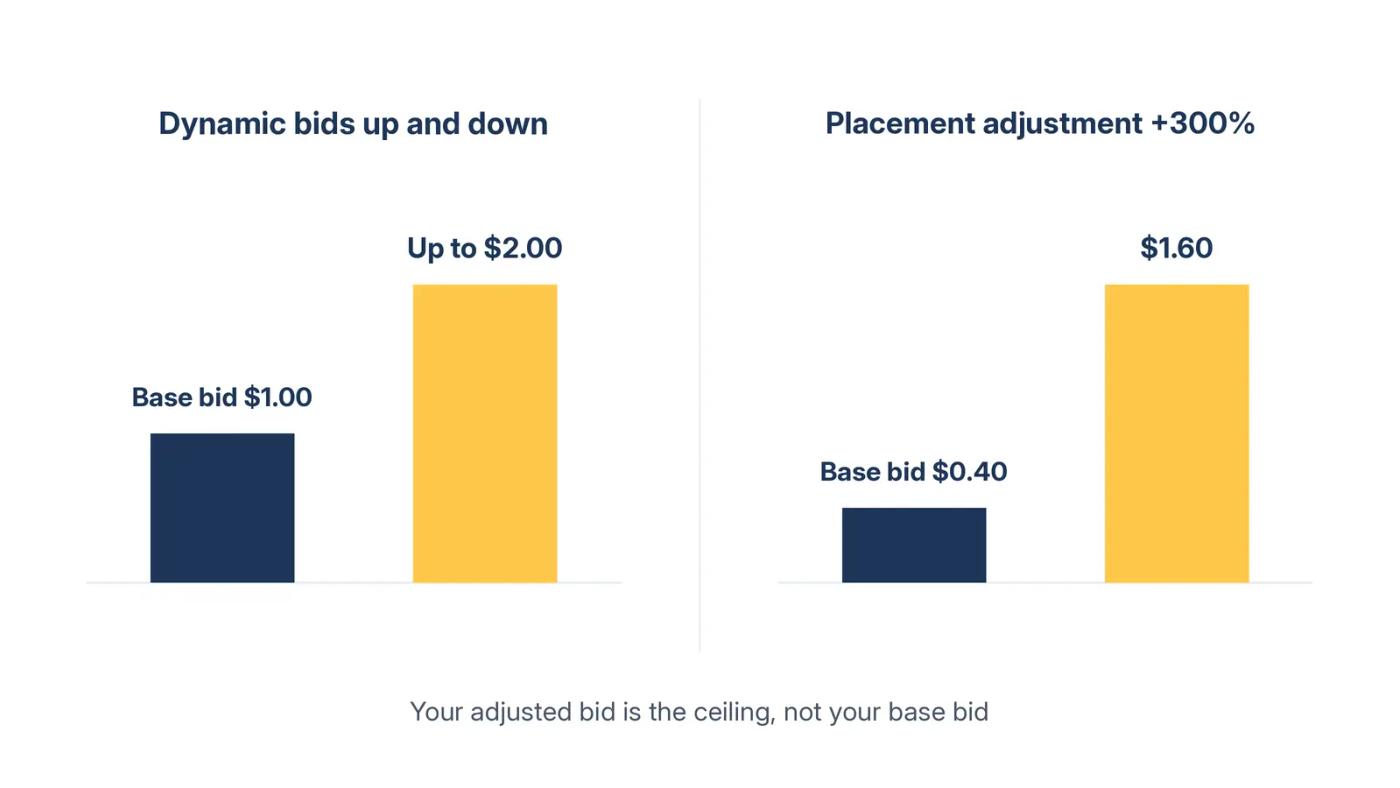
Do this: List every campaign using dynamic bids up and down or a placement boost. Recompute each true ceiling today.
Stop treating suggested bids as targets
The complaint says Amazon's console offers "suggested bid" amounts "to win auctions for impressions that can lead to clicks." My read: a suggested bid is built to win. Your ceiling is built to profit.
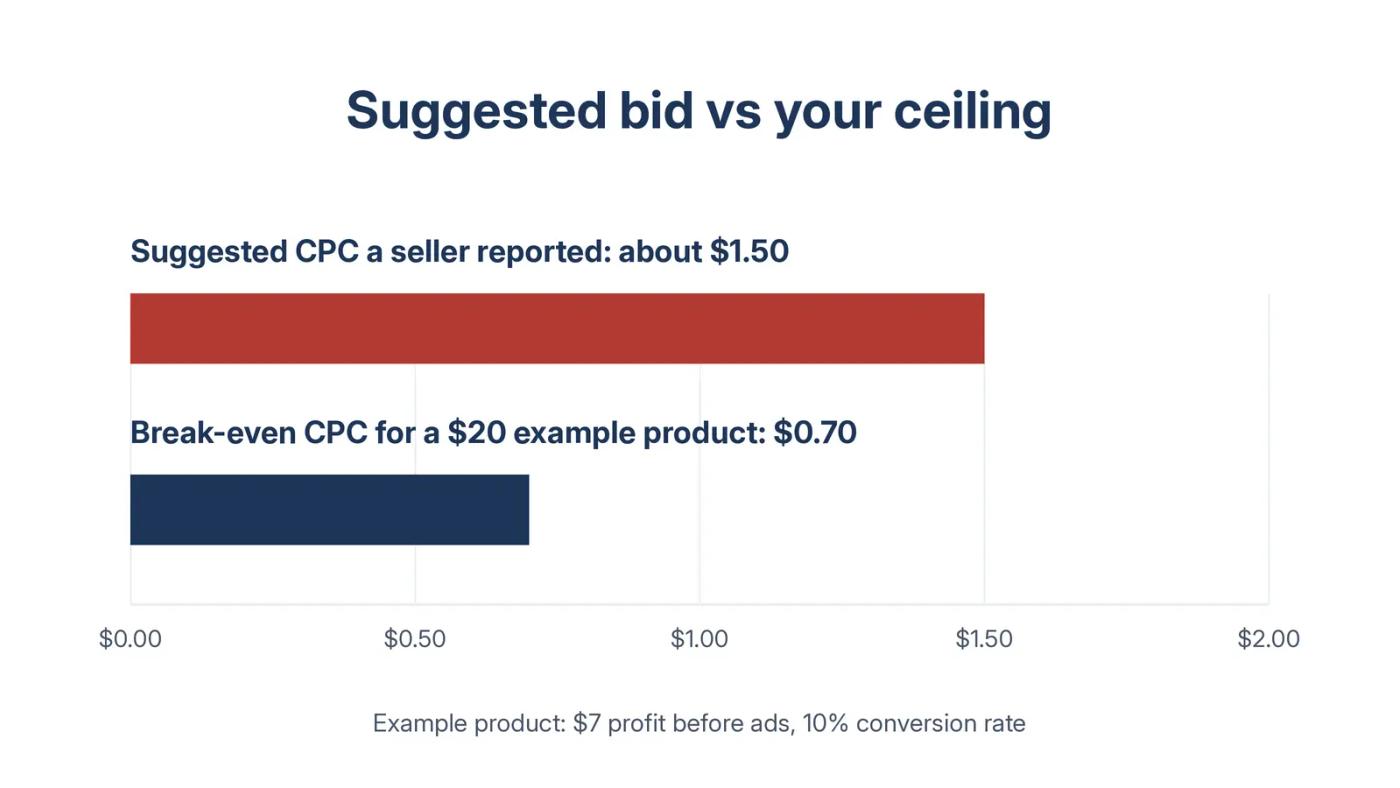
Sellers notice the gap. "Average cpc they recommend is always $1.50 range on our 15-25 products," one seller wrote on Amazon's Seller Forums in late 2025.
Run that through row one of the table. A $20 product with $7 profit before ads and a 10% conversion rate breaks even at $0.70. A $1.50 bid is more than double that.
A suggested bid still tells you something. My read: when it sits far above your ceiling, the term is crowded at prices you can't match. Move that budget to longer, more specific terms where your ceiling can win.
Check who gains from a higher bid
Two parties can earn more when your bids rise: Amazon, and any agency paid a share of your spend. Ask your agency how it is paid.
We charge a flat fee, so a higher CPC never raises our income. A fee set as a percentage of ad spend does.
Do this: Never paste a suggested bid. Compare it to your ceiling first, and bid the lower number.
Keep your own records starting this week
In the complaint, the states ask for restitution and "the refund of monies paid." Nobody knows yet if or how that would reach sellers. Records are cheap to keep now and hard to rebuild later.
What to save
Each week, save three things. Download a bulk file with your current bids. Download the targeting report with CPC and spend. Write a short note of any setting changes. Store all three outside Amazon.
Keep the columns that matter: date, campaign, keyword, match type, bid, CPC, clicks, spend, and orders. With those, you can rebuild your score for any week.
Why weekly
Your score only means something next to the bid that was live at the time. Bids change. A dated file shows what you paid and what you allowed.
Do this: Block 20 minutes every Monday. Download the bulk file and targeting report, then file both by date.
What you can't fix
You can't see the soft reserve. Amazon says no one can predict it in advance.
You can't see click-level prices. Reports show averages, so every score is an estimate.
You can't recover past charges with these steps. That sits with the court, on its own schedule. We won't guess a date.
Lower bids will cost you some impressions. Some terms will not pay at any bid you can afford. Let them go.
One limit on our side: we have not published a cross-account study of these scores. The 0.90 threshold is a working rule, not a finding.
Your bid reset checklist
- [ ] Read paragraphs 2, 65, and 76 of the FTC complaint
- [ ] Score your top 20 keywords: CPC divided by bid
- [ ] Flag every keyword scoring 0.90 or higher
- [ ] Work out break-even CPC for your top 10 products
- [ ] Set ceilings that keep a profit on every sale
- [ ] Halve base bids on up-and-down campaigns, or switch to down only
- [ ] Recheck every placement adjustment against its ceiling
- [ ] Compare each suggested bid to your ceiling before using it
- [ ] Save bids and CPC every week, filed by date
Where we fit
Amplivus runs Amazon ads for brands spending $10K or more a month. If you would rather not run these checks yourself, we run them for you.
Want to see where your ad spend goes before you change a single bid? Our free Amazon PPC audit is delivered within 24 hours. It traces every spend bucket across Sponsored Products, Brands, and Display. No pitch.
If your monthly ad spend is under $10K, the steps above are enough. Run them yourself.
Authoritative resources
- FTC press releaseThe August 31, 2026 announcement of the suit by the FTC and 22 states.
- FTC complaintThe full complaint, including paragraphs 2, 65, 76, and 106 to 108 on bidding.
- Amazon's responseAmazon's August 31, 2026 statement on hard and soft reserve prices.
- Amazon Ads dynamic bidding guideHow dynamic bids up and down can double a bid.
- Sponsored Products best practicesAdjusted bids, fixed bids, and placement adjustments up to 900%.
- Amazon Seller Forums threadA seller's report on suggested CPC versus product price.