How to Optimize Amazon PPC for Pet Brands at $200K+/mo
Read more

The best Amazon PPC manager for a pet brand runs emotion-led creative, keeps supplement and food claims compliant, and manages to lifetime value.
Summarize in ChatGPT

Hiring a pet PPC manager is an emotion and compliance decision, so vet for emotion-led creative, animal-claim fluency, subscription thinking, and seasonal command.
Hiring an Amazon PPC manager for a pet brand is not the same as hiring one for a generic catalog. Pet is deeply emotional, carries animal-specific claim rules, and runs on repeat purchase for the life of a pet. A manager who has only run plain consumer goods will misread all of it, and a careless claim on a supplement or treat can put the listing at real risk.
The global pet care market was valued at USD 181.9 billion in 2025 and is forecast to reach USD 283.7 billion by 2033, so the competition for an owner's loyalty is intense. This is a practical checklist for evaluating a senior Amazon PPC manager for a pet brand: the competencies that matter, the red flags to walk away from, the questions to ask, and what it should cost.
Pet combines an emotional buying decision, animal-specific claim rules, subscription-driven lifetime value, and real seasonality, so the manager you hire needs category-specific judgment, not general PPC skill. The category shapes the whole job, starting with emotion.
Emotion is the loudest difference. Owners treat pets like family, so the decision is driven by care and trust more than a spec sheet, and a manager who runs cold, feature-only ads misses what actually converts. Emotion-led creative is a real lever here, a foundation our guide to how pet brands scale on Amazon is built on.
Compliance is the difference that can get you pulled. Pet supplements and foods carry animal-specific claim rules, and advertising a disease benefit on a treat or supplement crosses a line that plain goods never approach. A manager who writes a careless health claim into copy exposes the brand in a way that few categories match.
The purchase repeats for years. Food, treats, and supplements reorder on a schedule, so a manager plans for the lifetime value of an owner rather than a one-time conversion. That replenishment thinking is foreign to a generalist used to static, one-and-done catalogs.
Judge any pet PPC manager against five competencies: emotion-led creative, animal-claim compliance, subscription economics, seasonal command, and transparent reporting. The table sums up strong versus weak on each.
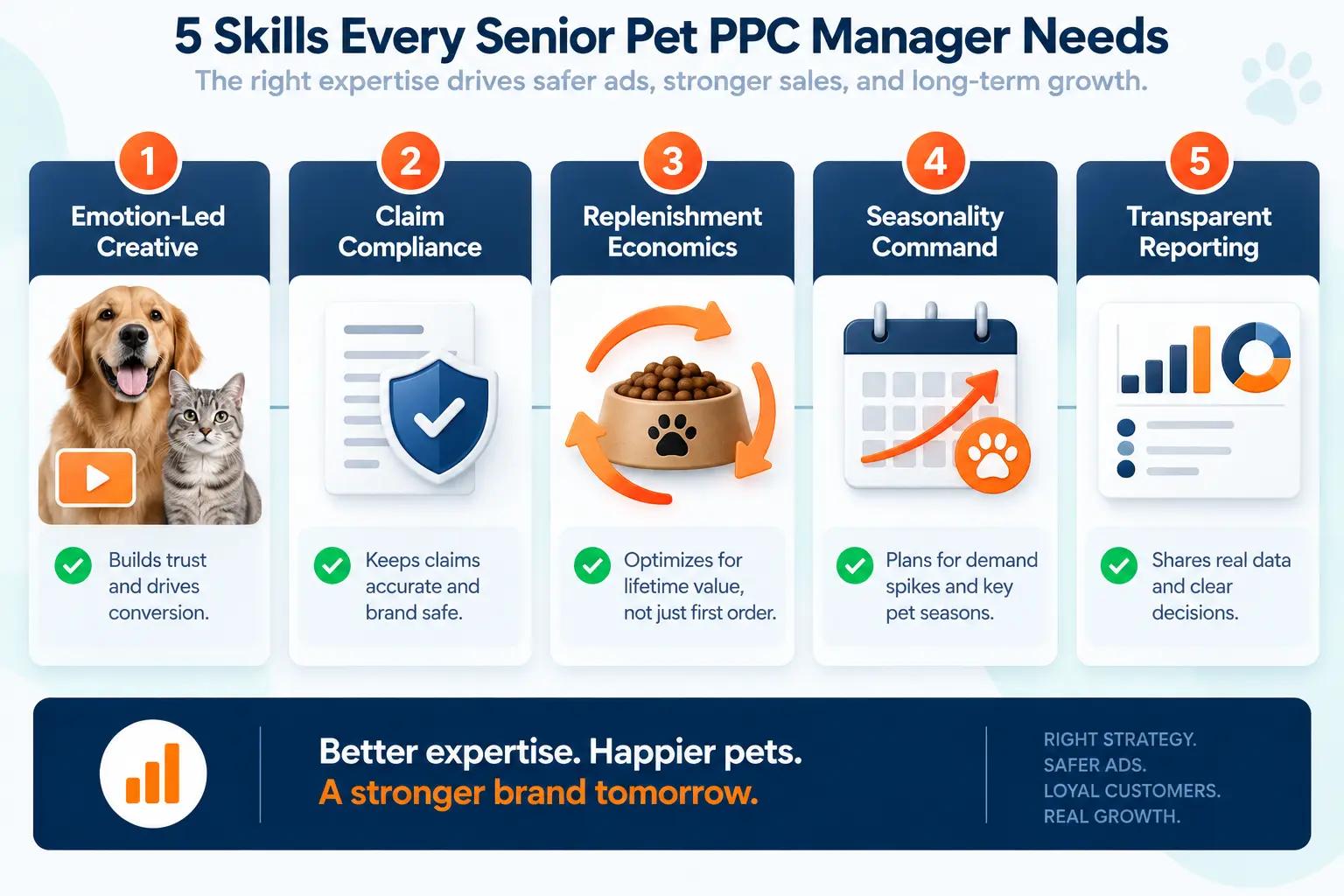
Pet sells on the bond between owner and animal, so creative is a lever, not a nicety. A senior manager runs emotion-driven creative for pet brands that speaks to how an owner feels about their pet, not just the ingredient list or the price.
Video carries that emotion where a static ad cannot. A senior manager runs Sponsored Brands with video to show a happy dog or a calm cat in a real moment, the exact approach our guide to Sponsored Brands Video for dog brands covers.
If you would rather not build that creative engine in-house, Sponsored Brands management is one way to get emotion-led advertising running without hiring for it directly. On a pet product, creative that earns trust often moves conversion more than a bid change.
Ask how they keep ad copy compliant before you ask about bids. Animal supplements are not covered by the human supplement law, so the FDA regulates a pet supplement or food as either a food or a drug based on its claims, and a treat that claims to treat or prevent a disease becomes an unapproved animal drug.
The practical rule is structure and function. A senior manager keeps copy on supporting joint health or a calm demeanor, never on curing arthritis or treating anxiety, because the keyword can target the concern while the claim stays safe.
Quality signals build trust with cautious owners. A recognized NASC Quality Seal shows a real quality program behind an animal supplement, and a senior manager knows where policy allows it to feature that kind of proof.
Substantiation covers the claims themselves. The FTC expects health claims to be backed by solid evidence, so a senior manager steers you toward benefits you can actually support rather than ones borrowed from a competitor's label.
Pets reorder for life, so a senior manager plans for replenishment rather than a single sale. Food, treats, and supplements move through Subscribe and Save, so the value of winning an owner is measured across months and years, not a first order.
A generalist optimizing to a low first-order ACoS will quietly starve growth. They cut the acquisition terms that look expensive on day one but pay back across an owner's lifetime, and the account looks efficient while the subscriber base stops growing.
The right manager models the reorder. They know an acquisition cost that looks high against a single bag of food can be excellent against years of refills, and they bid accordingly rather than judging every sale in isolation.
Retention is the quiet multiplier. A senior manager protects the subscribers you already have as carefully as they chase new ones, because a lapsed reorder costs far more than a single missed sale in a category where a loyal owner keeps buying for the life of the pet.
Pet demand is not flat, so a senior manager plans for the calendar. Anxiety and calming products spike around fireworks, storms, and the fourth quarter, the seasonal pattern our guide to pet anxiety category demand maps out in detail.
Gifting and staples round out the picture. Owners buy gifts for their pets during the holidays, while food and litter stay steady all year, so a manager sequences budget across a mix of seasonal and evergreen demand rather than treating the whole catalog the same way.
Inventory has to move with the calendar too. A calming product that sells out the week of a holiday wastes the demand a campaign built, so a senior manager plans stock and spend for the spike together rather than reacting once the shelves are empty.
You should own your account and see the raw numbers. A senior manager explains decisions in plain language from your own Brand Analytics data, never a black-box dashboard, and manages toward profit and lifetime value rather than a vanity ACoS.
Ownership belongs in the checklist too. Your advertising account, your historical data, and your Brand Registry enrollment should stay yours, so that if the relationship ends, nothing walks out the door. Anyone who resists that is protecting themselves, not you.
Some signals should end the conversation early. Each one tends to predict a poor engagement on an emotional, compliance-sensitive pet account.
Most of these share a root cause: a generalist applying a flat, unemotional playbook to a category built on love, trust, and repeat purchase. If a candidate cannot speak fluently about creative and claims in the first conversation, the rest of the checklist rarely saves the hire.
Ask questions that reveal how the manager thinks, not just what they sell. The answers separate a senior operator from an order-taker.
Ask them to explain when a pet supplement claim becomes a drug claim, and to give an example of ad copy they would reject. A fluent, specific answer is the fastest way to tell a pet specialist from a generalist who will get you in trouble.
Ask how they would find waste in your account in the first month. A strong answer names specifics, and their approach should echo Amazon's own Sponsored Products best practices: raise bids on proven converters, cut the weak ones, and structure for control.
Ask how they measure lifetime value across reorders, how they plan for anxiety season, who runs the account day to day, and whether you can leave without penalty. Then ask for a reference at your scale, because a real pet brand that trusts them will tell you in five minutes what a sales call never will.
Ask for specific, verifiable results on brands like yours, not logos or vague claims of growth. Category proof matters more than a long client list.
A strong candidate can describe a pet account they improved: what was broken, what they changed, and what happened, in concrete terms. Vague answers about driving growth usually mean the specifics do not exist.
Ask specifically about compliance-sensitive and subscription-driven accounts, because a manager who has only run plain goods has never faced the two hardest parts of pet, and a spend view like our pet brands spend tier guide helps you judge whether their numbers are realistic.
Pricing usually follows one of three models, and each has trade-offs worth understanding before you sign. None of them is automatically the right fit.
A percentage of ad spend is common but can reward spending more, which fits a lifetime-value category poorly. A flat monthly retainer is predictable and neutral on spend, and a performance or hybrid fee ties part of the payment to results.
What matters more than the model is that the fee rewards your profit and your subscriber growth, not just your ad budget. Several factors move the number: your ad spend, catalog width, how much compliance review the copy needs, and whether creative is included. Ask exactly what is covered, what counts as extra, and how the fee changes as you grow.
Not every pet brand needs an outside manager, and a good one will tell you so. The honest answer depends on your catalog, your margins, and your team.
If your catalog is simple, your margins are healthy, and your in-house lead already runs claim-safe and measures lifetime value, hiring out may add cost without adding much. There is no shame in staying in-house when in-house is working.
An expert or agency earns the fee when compliance risk is real, when subscription economics are on the table, or when growth has stalled in a crowded category. A single senior hire gives you depth in one person, while an agency gives you a bench and a second check on every claim. If none of that describes you, staying in-house is valid.
Expect a compliance and creative audit before action, then phased changes, not an overnight rebuild of an account you spent years building. Good managers move deliberately.
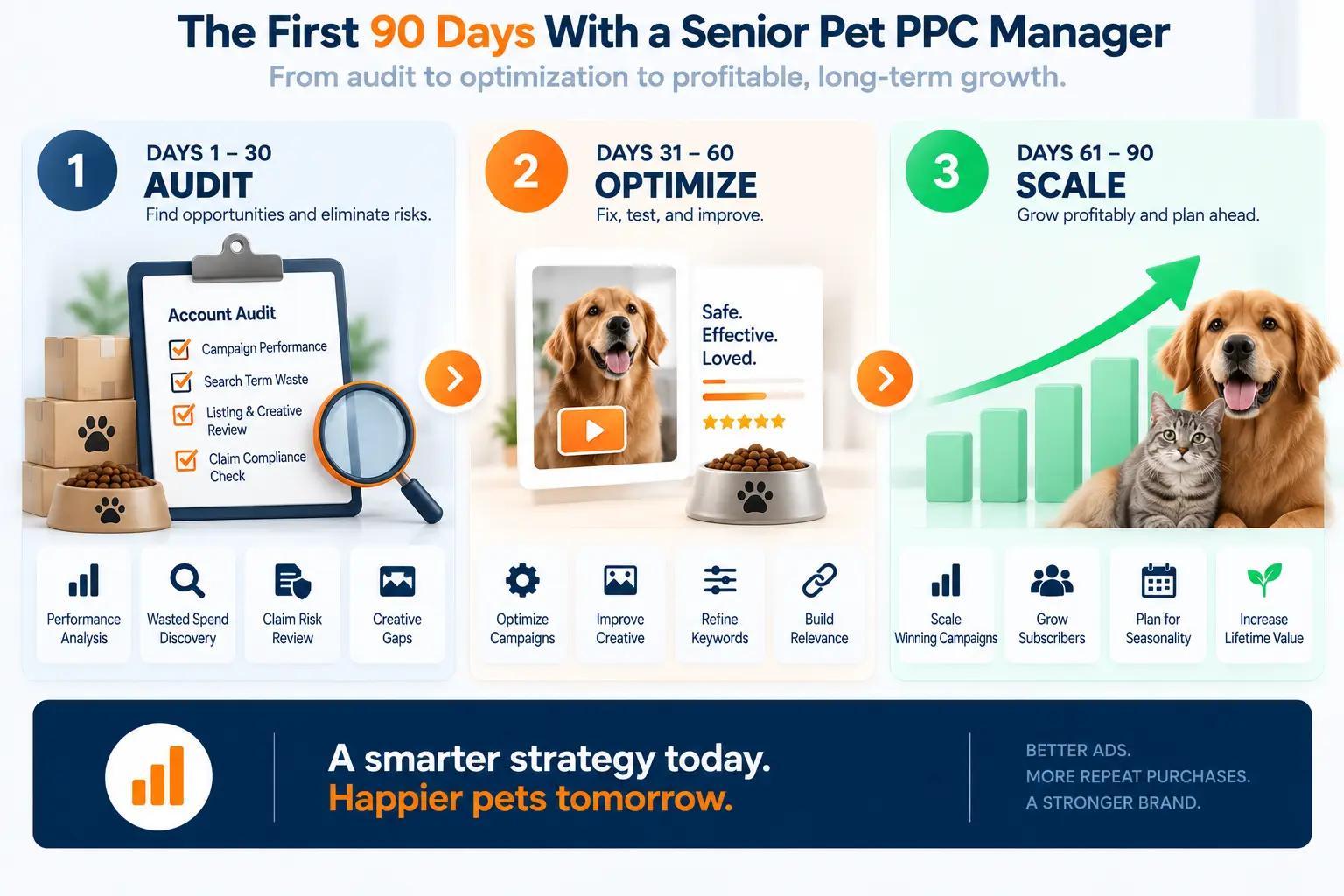
In the first weeks, expect a real audit: where spend is wasted, which listings carry claim risk, and which ones lack the creative to earn an owner's trust. You should see findings, not just a new dashboard.
By month two and three, expect deliberate changes with reasons attached, claim-safe copy where the old copy was risky, and a plan built around emotion, reorder value, and the season ahead. A wholesale teardown on day one usually destroys rank and reviews you paid months to earn, which is the opposite of what a senior hire should do.
As a specialist Amazon PPC agency, Amplivus staffs pet brands with senior managers who run emotion-led creative, keep copy claim-safe, and manage to lifetime value, all from inside your own account.
Day to day, that means disciplined Amazon PPC management built around the emotion and compliance realities of pet, not a generic playbook applied the same way to every category.
The right first step is proof, not a contract. A free Amazon PPC audit shows where your account is leaking and where claims carry risk.
From there, a short Amazon strategy session turns those findings into a compliant, emotion-led plan for the year ahead.


Work with a pet PPC specialist who understands claim rules, emotional creative, lifetime value, and seasonal demand needed to scale profitably.
See who can manage pet claims, emotional creative, subscriptions, and seasonality before you trust them with Amazon growth.