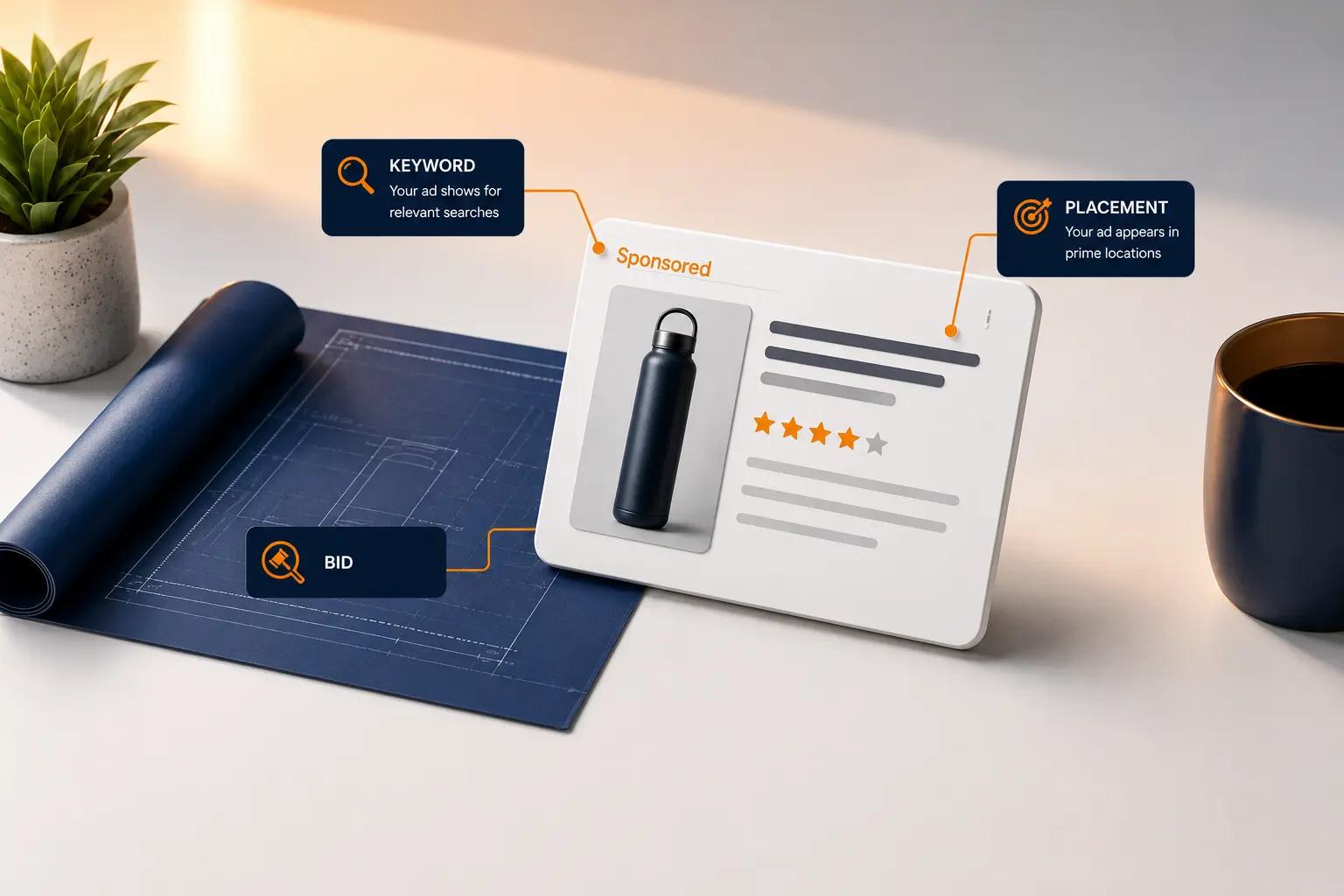
Amazon PPC Strategy for Supplement Brands Doing $200K+/mo
Read more

For fitness equipment brands, build Amazon PPC around contribution margin, not flat ACoS. Use fee-aware bids, brand defense, Q1 pacing, and add DSP only after search campaigns are profitable.
There is a moment most fitness-equipment brands hit around $200K a month. Ad sales keep climbing, but the profit line flattens or dips. The reflex is to push harder on bids. That reflex is what is draining you.
Here is the thing the generic guides skip. A tactic that mints money on a $19 resistance band can quietly bankrupt you on a $600 power rack, because the two products carry completely different fee loads and completely different room to pay for a click. Advertising heavy, high-ticket equipment is its own discipline.
Get the math right and paid becomes the most reliable growth channel you have. Get it wrong and you are buying revenue at a loss without seeing it.
This guide is for brand owners and in-house ad managers running real volume on bulky catalogs: racks, benches, cardio, strength systems, and the accessories around them.
It builds on our broader playbook for how fitness brands scale past $100K a month on Amazon PPC, with the fee math and structure that high-ticket equipment demands.
The standard playbook assumes light margins of error and cheap fulfillment. Fitness equipment has neither.
Your fees are high, your average selling price is high (fitness is one of the larger consumer-durable categories bought online in the US, per Statista), and your buyer takes longer to decide, so the usual "bid up on anything that converts" advice works against you.
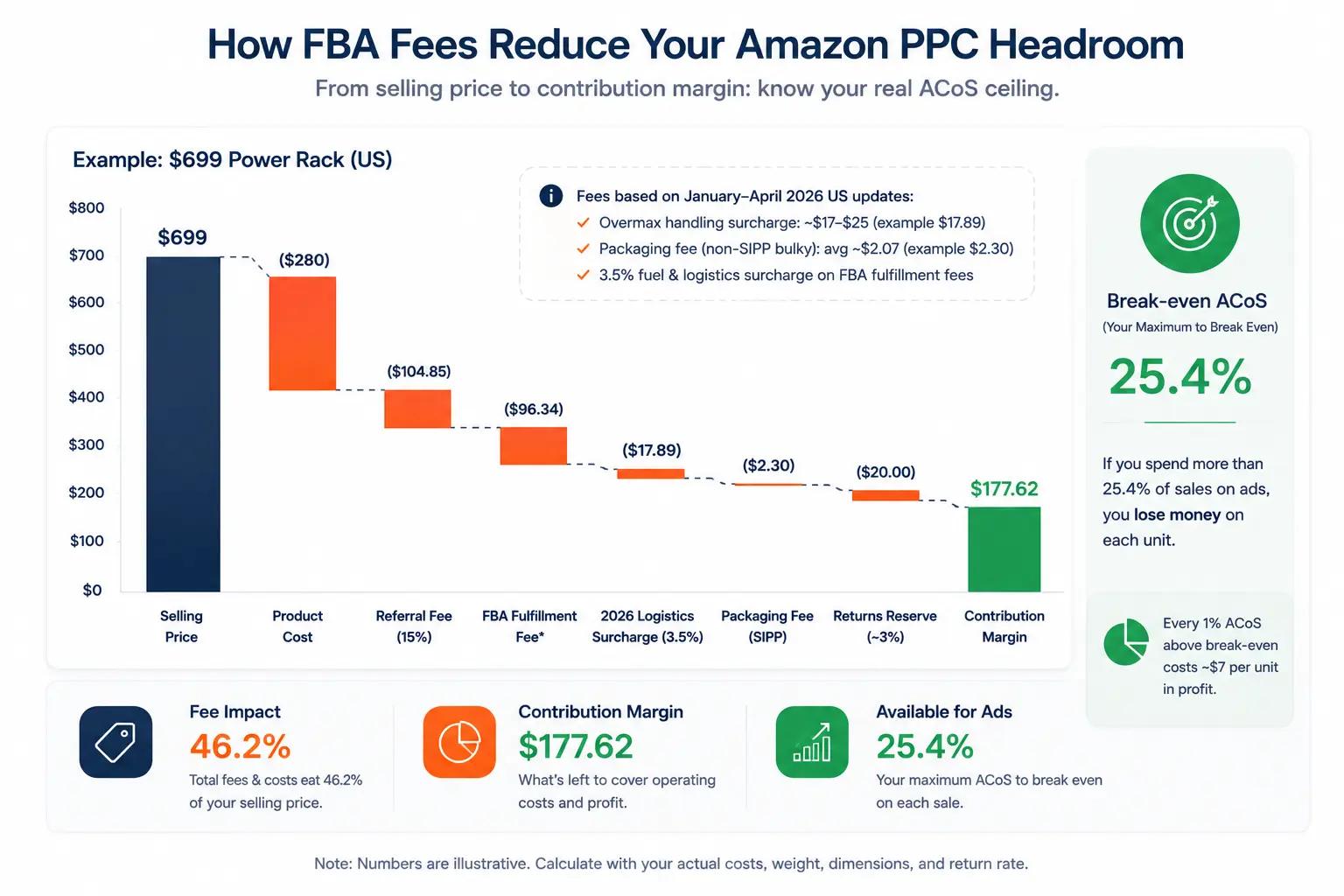
Start with the fee that decides everything: Fulfillment by Amazon (FBA). Gym equipment lives in the oversize and bulky tiers, and Amazon's 2026 US fee changes made those tiers more expensive.
The largest oversize items now carry a per-unit handling surcharge, and small and large bulky products not enrolled in Ships in Product Packaging (SIPP) picked up a packaging fee that runs from roughly $1.50 to $4.00 per unit.
On top of that, a 3.5 percent fuel and logistics surcharge applies to FBA fulfillment fees from April 17, 2026, and Amazon bills on the greater of dimensional or unit weight, which punishes anything light but boxy.
Confirm the current rates for your exact dimensions in Seller Central, since Amazon updates the schedule, but the direction is clear: the floor under heavy SKUs went up.
Why does this matter for ads? Because your Advertising Cost of Sale (ACoS) ceiling is not a number you copy from a blog. It is whatever your contribution margin per unit allows after those fees.
Two brands can sell the same treadmill at the same price and have completely different break-even ACoS, purely because one shaved 40 pounds of dimensional weight off the box.
The second difference is the buyer. Someone spending $700 on a home gym does not impulse-click and check out.
They compare, they read the product detail page twice, they leave and come back. That long consideration cycle is why mid-funnel and retargeting placements carry more weight here than in an impulse category, and why a single last-click ACoS reading understates what your ads are really doing.
A good ACoS for fitness equipment is any figure comfortably below your contribution margin after FBA fees, not a fixed benchmark.
For most high-ticket gym products that lands lower than the light-goods averages you see quoted, because the fee load eats the room a cheaper product would have. Work it from the unit up.
Take your selling price, subtract product cost, the FBA fee including the 2026 surcharges, referral fee, and returns reserve. What remains is your contribution margin. Your break-even ACoS equals that margin expressed as a percent of price.
You then steer below it, with how far below depending on where the product sits in its life.
A power rack with 55 percent contribution margin can run a growth ACoS in the high twenties and still profit.
A cardio machine at 22 percent margin cannot, and any advice telling it to "bid aggressively" is telling it to lose money.
The metric that should actually run your account is Total Advertising Cost of Sale (TACoS): ad spend against total revenue, organic included.
On a considered purchase, ads lift organic rank, and rising organic sales with a steady ad spend show up as falling TACoS even when campaign ACoS looks flat.
That is the number that tells you paid is building the business rather than just renting sales, and it is the same north star our guide to scaling Amazon PPC past $100K a month steers by across every category.
Structure a $200K catalog by role and margin tier, not by throwing every ASIN into one campaign. The goal is that every dollar has a job you can name, and every hero SKU gets isolated so you can control its bids precisely.
Sponsored Products does the heavy lifting. Use manual campaigns split into keyword targeting and product targeting, with your three positive match types (broad, phrase, exact) sculpted by negatives so broad discovery does not bleed into your exact winners.
Reserve one auto campaign per group purely to harvest new search terms, then graduate the converters into manual.
For your top revenue SKUs, run tight single-keyword or single-theme ad groups so a bid change hits one target, not fifty.
On bidding, fitness equipment is where Rule-Based Bidding (target ACoS or target ROAS) earns its keep, because your margins are too thin to babysit manually across a broad catalog.
Keep Dynamic bids down-only on your fee-heavy SKUs so Amazon cannot raise a bid into a placement you cannot afford. Then layer the brand formats:
Keep two things in separate buckets with separate targets: brand defense (bidding on your own brand terms) and conquesting (bidding on competitor ASINs and terms like Bowflex, NordicTrack, or Rogue Fitness).
Brand defense should run at a low ACoS because the intent is already yours. Conquesting runs hotter and needs a hard margin gate, because you are paying to interrupt someone shopping another brand.
That harvest-and-graduate loop runs on your Search Query Performance report, which shows which terms actually convert before you commit manual budget.
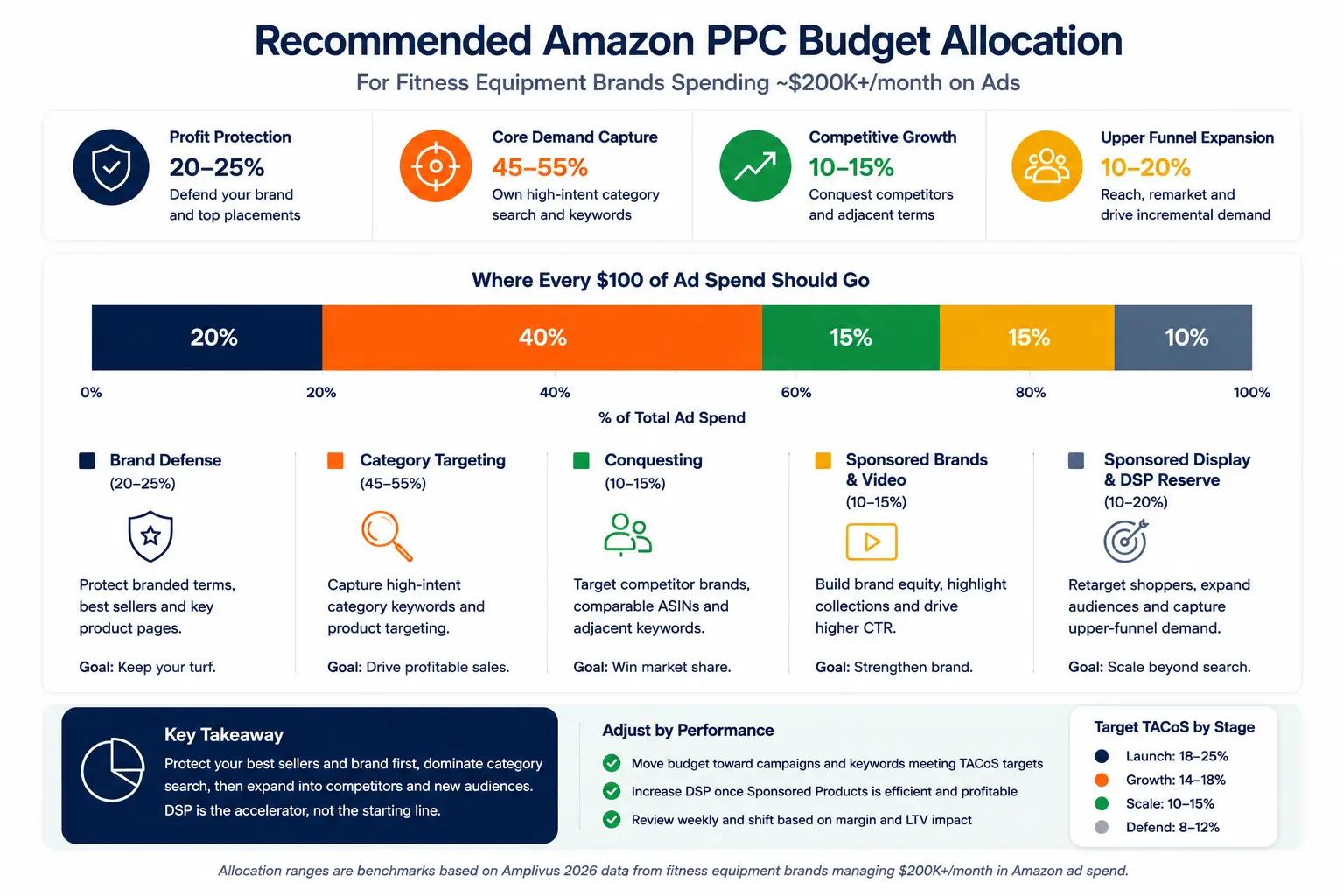
At $200K a month, split budget by priority of return: protect what is already yours first, then buy category share, then expand the funnel.
A workable starting allocation once your account is stable looks like this.
Treat the split as a dial, not a rule. If your brand is being conquested hard, brand defense rises. Heading into Q1, category and retargeting rise together.
The one line that should never hit zero is brand defense, because leaving it open invites competitors to buy your own customers on the way to your listing.
Much of the retargeting work runs through Sponsored Display audiences, which are the cheapest way to stay in front of a shopper who is still comparing.
Plan for January as the biggest window of your year.
Exercise equipment shows one of the largest fourth-quarter-to-first-quarter demand increases of any consumer-durable category, and fitness equipment is among the top durable-goods categories people buy on Amazon.
New Year resolutions concentrate that demand into a few short weeks, which is exactly why pacing matters more here than in a steady category.
That concentration changes how you pace. Budgets should ramp in late December, not on January 2, because the auction heats up before the calendar turns and early impressions build the rank you cash in during the rush.
Bid ceilings can rise through the peak since conversion rates climb with intent, then normalize in February as the resolution crowd thins.
The trap is inventory. The fastest way to waste January spend is to win auctions for a SKU that goes out of stock mid-month. Inventory-aware bidding means pulling bids down as cover gets thin, so you are not paying for clicks that end in an unavailable listing and a damaged rank.
Map your ad ramp to your restock timeline, protect your proven winners, and let the marginal SKUs run lean.
A quiet October is the right time to build this plan, and our walking pad Q4 planning guide walks through the same corridor-budget approach for a lighter fitness product.
Add Amazon DSP (Demand-Side Platform) once your Sponsored Products and Sponsored Brands base is stable and profitable, and you can fund retargeting without starving search.
Not before. DSP is powerful on a considered purchase, but it burns budget fast if you switch it on to fix a search account that is not yet working.
The natural entry point is retargeting. Your high-ticket buyer views the product detail page, leaves to compare, and takes days to decide.
Amazon DSP keeps you in front of them on and off Amazon during that window, which is exactly where a long consideration cycle leaks. Once retargeting proves out, expand into in-market and lifestyle audiences.
Amazon Marketing Cloud (AMC) is the next layer, and its best use in fitness is the second sale. Someone who bought a rack needs plates, attachments, a mat, a bench.
AMC Audiences let you find those repeat and accessory buyers and build lifetime value rather than paying full freight to acquire each purchase cold.
Pair it with Maximize New-to-Brand bidding on the reach campaigns where you actually want first-time households, and read New-to-Brand (NTB) metrics to confirm you are buying growth, not just re-buying existing customers.
Brand Analytics and Search Query Performance sit underneath all of this, showing you the exact search terms and share your category is winning or losing.
Use video to answer the questions a static image cannot: how big is it, how does it move, will it hold my weight, how hard is the assembly.
For heavy equipment, that reassurance is the whole ballgame, and it is why Sponsored Brands Video and Sponsored Display Video tend to convert better than static on higher-priced, considered purchases, which is most of a fitness catalog.
Show the three-second fold of a treadmill, the footprint next to a person, the plate loading onto a rack, the weight rating in use. Buyers spending real money are trying to picture the thing in their apartment and trust it under load.
A clip does that in a way five images never will. Video also matters for how discovery is shifting.
Amazon's Rufus assistant, moving toward Alexa for Shopping in 2026, increasingly answers shoppers in plain language, so people search by situation, not just keyword: "home gym for a small apartment," "quiet cardio for upstairs."
Your listings, A+ content, and video should speak to those intents directly, because that is the language the assistant matches against when it surfaces and describes products.
The expensive errors in this category are rarely dramatic. They are steady leaks that a margin lens would have caught.
The first is bidding like a light-goods seller. "It converts, so bid up" ignores that the converting sale might be underwater after the oversize fee. Every bid decision on a heavy SKU has to pass the contribution-margin check first.
The second is running no brand defense. Leave your brand terms open and a competitor will buy the shopper who was already coming to you, and you pay in lost sales while they pay pennies to intercept.
The third is a flat budget across a seasonal category. Spending the same in July and January means overspending in the quiet months and underspending in the one window that actually pays.
The fourth is conquesting without a gate. Competitor targeting is worthwhile, but it runs hot, and without a hard margin ceiling it turns into expensive brand awareness you did not budget for.
The last is letting winners go out of stock in Q1. Nothing wastes ad money faster, and nothing is more avoidable with inventory-aware bidding and an honest restock plan.
You do not fix all of this at once. Sequence it so each phase funds the next.
Weeks 1 to 3, get the math right. Pull true contribution margin per SKU with the 2026 fees counted. Set a break-even and steering ACoS per product.
Turn on brand defense immediately, since it is the cheapest revenue in the account. Add negative keywords to stop broad campaigns from bleeding into exact winners.
Weeks 4 to 8, build the engine. Restructure Sponsored Products by role and margin tier with single-theme ad groups on hero SKUs.
Move rule-based bidding onto the broad catalog. Stand up conquesting with a margin gate. Launch Sponsored Brands Video and Sponsored Display retargeting. Harvest search-term data weekly and graduate converters.
Weeks 9 to 12, expand and pace. Once search is stable and profitable, bring DSP in for retargeting, then audiences.
Layer AMC for accessory and repeat buyers. Build the Q1 pacing calendar now: budget ramp, bid ceilings, and an inventory map so proven SKUs never go dark in the surge.
Run it in that order and paid stops feeling like a leak and starts compounding: ads lift rank, rank lifts organic, TACoS falls, and the profit line finally moves with your revenue instead of against it.
You do not need an agency to understand any of this.
But if you would rather have a specialist pressure-test your fee math and campaign structure before Q1, that is exactly the kind of teardown we run as an Amazon PPC agency for fitness-equipment brands, through ongoing Amazon PPC management, a focused Amazon PPC audit, or a short Amazon strategy session.
Either way, start with the margin. Everything else follows from it.

Talk with an Amazon PPC strategist to improve fee-aware bidding, protect margins, and scale your fitness equipment brand with confidence.
Get a detailed Amazon PPC audit to uncover margin leaks, improve campaign structure, and scale heavy equipment profitably.